

Easy Inventory operations guide
Easy Inventory keeps selling and warehousing in one place: you order from suppliers, receive goods into the warehouse, sell at the counter or take orders from marketplaces, pick and ship, then count stock periodically to make sure the numbers match the shelves. This guide follows those jobs. Each page covers one complete job you can finish, not a screen-by-screen tour.
If the system is new to you, start with the rollout order. If you are looking at a screen and are not sure which job it belongs to, use the screen lookup table at the end.
How goods move through the system
Seen from above, every operation in Easy Inventory is one leg of the same journey. Goods enter through a stock-in entry, sit in stock, then leave by one of several exits: sold at the counter, shipped against an order, written off or returned to the supplier, or transferred to another warehouse. Counting is the loop that brings the system back in line with reality.
Each leg has its own page:
| Leg | Page |
|---|---|
| Order and receive goods | Purchase and receive |
| Goods inside the warehouse: issue, transfer, adjust | Issue, transfer, and adjust stock |
| Sell directly to customers | Sell, return, and use kiosk |
| Orders arriving from channels | Process channel orders, then Pick, check, and ship |
| Bring system numbers back to reality | Count and reconcile inventory |
Every stock change goes through a document
Easy Inventory never lets anyone type over a stock number. To change stock, you create a document: a stock-in entry, a stock-out entry, a transfer, or a count adjustment. That is why the stock ledger can always answer the question "where did this number come from".
Every warehouse document moves through the same states:
Three things worth remembering:
- A document in Draft or Submitted has not touched stock yet. If stock "did not go up" after receiving, the document is almost certainly still waiting under Stock Documents → Stock Receipts.
- If your company has not turned on mandatory approval, documents go straight from submission to Completed without the waiting step.
- Transfers add an in-transit gap: goods have left the source warehouse but not yet arrived at the destination. The issue and transfer page covers that gap in detail.
What you are trying to do
Find the row that matches your job and open the page:
| You need to | Read |
|---|---|
| Bring the system live for the first time | Set up the system, then Catalog and warehouses |
| Order from suppliers, receive into the warehouse | Purchase and receive |
| Issue stock, transfer between warehouses, adjust | Issue, transfer, and adjust stock |
| Pick and check orders before shipping | Pick, check, and ship |
| Sell at the counter, handle returns, run a kiosk | Sell, return, and use kiosk |
| Handle orders coming in from sales channels | Process channel orders |
| System stock does not match what is on the shelf | Count and reconcile |
| Attach tags, read tags, count with RFID | Manage RFID |
| Track debt, manage consignment stock | Debt and consignment |
| Review sales and inventory numbers | Review reports |
| Add users, control access | Users and security |
| Turn on modules, connect other systems | Settings and integrations |
| An action fails or numbers look wrong | Troubleshooting |
What order to follow on a new rollout
The first four steps must run in order, because each one feeds the next:
- Set up the system: company details, modules, warehouse rules.
- Create the catalog and warehouses: documents created later need products and warehouses to pick from.
- Load opening stock with stock-in entries.
- Issue and transfer once goods start moving.
Skip the catalog step and you hit a wall immediately: stock-in entries have no products to add and the POS screen has nothing to sell. After these four steps, read the remaining pages as the need comes up, in any order.
Find a page by screen
You are on a screen and want to know which job it belongs to. The left column shows menu items exactly as the interface displays them:
| Menu item | Page |
|---|---|
| Dashboard, Reports | Review reports |
| Products, Product Categories, Warehouses | Catalog and warehouses |
| POS, POS Sessions, Vouchers | Sell, return, and use kiosk |
| Order History | Sell, return, and use kiosk, Process channel orders |
| Customers, Debts, Consignment, Consignment reports | Debt and consignment |
| Suppliers, Purchase Orders, Stock In | Purchase and receive |
| Stock Out, Stock Transfers, Stock Ledger | Issue, transfer, and adjust stock |
| Pick Lists, Goods Issue Notes, Verify Order | Pick, check, and ship |
| Stock Receipts (documents awaiting approval) | Purchase and receive, Issue, transfer, and adjust stock |
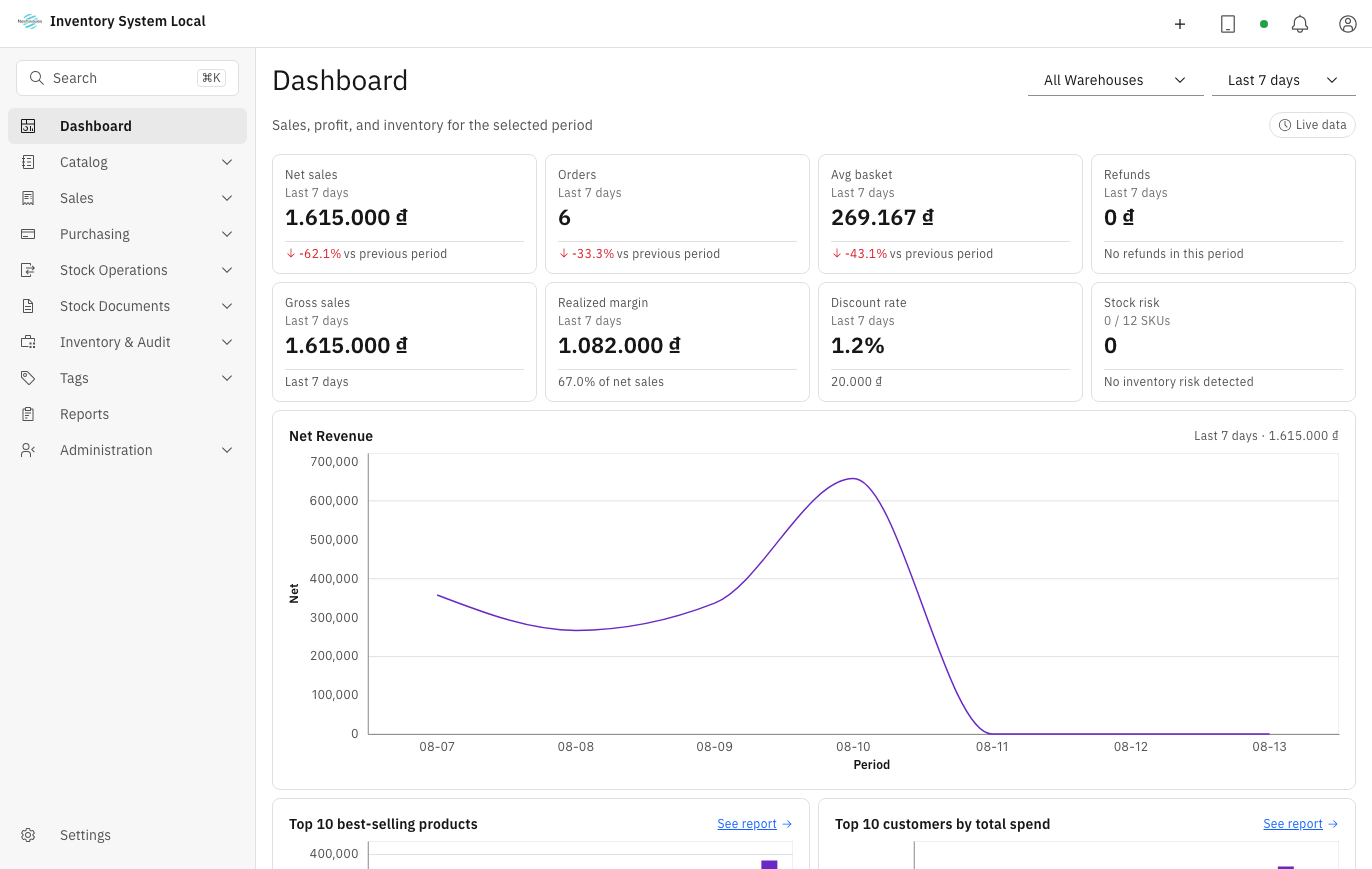
| Stock Levels, Stock Audit | Count and reconcile |
| Remote Sync | Process channel orders |
| Tag List, Tag Inspect, Map locations, Scan to Remove, Removed Tags, Check Item | Manage RFID |
| Users, Roles, Permissions, Activity Logs | Users and security |
| Settings: General Settings, Features, Inventory settings | Set up the system |
| Settings: Integrations, Shipping carriers | Process channel orders |
| Settings: Payment Gateways, Printing, the Kiosk group | Sell, return, and use kiosk |
| Settings: RFID Readers, MQTT Config, Pair a Tablet | Manage RFID |
| Settings: the Security group | Users and security |
| Settings: API Access, Webhooks, AI Integration, Telemetry, Sample Data | Settings and integrations |
How to read these pages
Every task page opens with the outcome you are working toward, lists prerequisites only when the job can be blocked by them, numbers the actions in the order you perform them, and ends with what to check when the numbers do not add up.
Bold text is a label shown on the English interface, so you can match it against the screen in front of you. If your interface runs in Vietnamese, switch to the Vietnamese guide.
If a menu item mentioned in a guide is missing from your screen, one of three things is true: the module is turned off, the subscription plan does not include the feature, or your account lacks the permission. That is not a system fault; Users and security and Settings and integrations show where to check.
"Operational guidance" callouts are practices worth following; the software does not enforce them for you.